

An Anglophone writer living now partly in France, well-versed in French leftist philosophy, brings out with much fanfare a novel that uses the serious French farmers’ and ecologists’ aggravation over ‘mega-reservoirs’ as background and hook. I’ll be curious to see what French readers make of this fiction, once translated. Meanwhile, the Arts Fuse published my humble out-of-the-mainstream opinion. (And if you hunger for reality, look for a fresh PdV, at long last, next month.)
Book Review: “Creation Lake” — A Jumble of Fact and Whimsical Imagination
October 4, 2024
By Kai Maristed
Rachel Kushner’s latest novel is a mélange of vignettes, stand-alone or linked flash essays, and portentous bits of wisdom.
Creation Lake by Rachel Kushner. Scribner, NY, 404pp, $29.99.
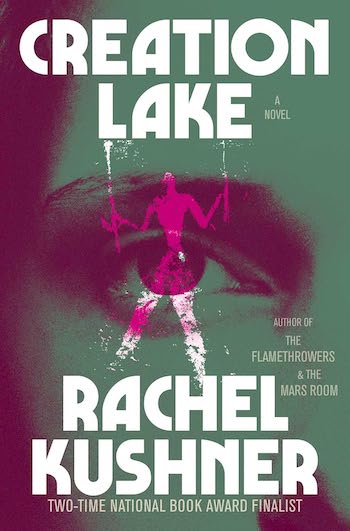
To lovers and scorekeepers of contemporary American literature, Rachel Kushner needs little introduction. After five volumes of fiction and essays, she is a two-time National Book Award finalist, once short-listed for the Booker, and this year again Booker short-listed for her sixth book, Creation Lake — a “gripping philosophical thriller,” according to cover blurber Hernan Diaz. On that premise, or promise, one opens to the first of 404 pages with a deep greedy inhale, like a chocaholic unwrapping a box of Vosges Truffles.
Speaking of similes, and before we go further, let it be noted that Kushner has a delightful gift for apt and sometimes hilarious comparisons. “Tall, craggy mountains stretched across the horizon like a diabolical curtain, sharp and jagged, frozen black flames against the sky.” Or: “The boy was washing pots with a high-pressure hose that hung from the ceiling and snapped up like a Poma-lift when he let go.”
She also has a fondness for the one- or two-sentence paragraph, which sometimes lends the first-person narration a staccato rhythm. Like a smattering of bullets.
The book’s gun-toting narrator, Sadie Smith (not her real name), is an American undercover operative who dropped out of a PhD program to work first for the Feds — infiltrating a biker gang — then freelance, currently in rural Southwestern France. We do not learn much more about her past, nor her motivation for this dangerous and solitary line of work, other than that she is misanthropic, likes the money, and that this is what she considers independence, although during much of the book she’s apprehensively alert for a double-cross by her own shadowy unknown bosses, or “connections.” She apparently also gets a kick out of betraying people she’s seduced (with a Darwinian rationalization about leaving born suckers to take the rap). In her late 30s, she describes herself as having “large breasts that do not require a bra” (not her real breasts), an otherwise perfect figure (although she never exercises and drinks impressively), and bland white-girl features. Even with these descriptors, I find her hard to visualize.
In her feisty go-it-alone-ness Sadie is a sister to previous Kushner protagonists: smart, snide, tough, and wary. Big girls don’t cry and, in Sadie’s case, they are not squeamish about putting out to get what they want. She is too skilled at mocking others with her biting wit to suffer a twinge of self-doubt. In other words, Sadie is not a terribly likeable person. Nor a very credible one, and so by the book’s midpoint I cared little about whether she accomplished whatever mysterious task for whomever, or not. Other characters in the novel are even less fleshed out. The exception is Bruno, an elusive cave-dwelling sage with a tragic past whose intercepted rambling emails preoccupy Sadie increasingly as the book goes on — and take up much of it.
Sadie is also a slob, happy to trash the house that’s been lent to her by Lucien, the guy she seduced into “marrying” her after she picked him up in the Bois de Vincennes while posing as a dog walker looking for more upscale work, and who is conveniently off in Marseille shooting a film. Why Lucien? Because he is an old pal of Pascal, the head of a community of back-to-the-earthers that her “connections” suspect of plotting resistance to the project of building a mega-basin or reservoir that they contend would drain water from all the surrounding aquifer and streams.

Author Rachel Kushner — returning intellectualism to American letters? Photo: New Directions
I live in France, so I’ve been following the real-life demos, encampments, and legal struggles over these water-gobbling government-sponsored mega-reservoirs. I was excited to learn that Kushner had chosen this subject. In my opinion, and that of many (presumably Kushner, too), the reservoirs (the size of multiple football fields, dirty and rectangular, hardly lake-like) are essentially a gift of the State to Big Agriculture, destined to ruin the local ecology and smaller farmers. Goncourt-winning writer Michel Houellebecq wrote presciently about such neopeasant revolts in his earlier (2019) novel Seratonin. In Creation Lake he is lampooned as Michel Thomas, he of “the frayed hair and ill-fitting dentures, who was touring this area as research for an ‘agronomy novel’— whatever that was.”
The above pretty much sums up the central story, although it’s not a spoiler, because Creation Lake, despite its billing as a thriller, consists mainly of lead-up exposition, and associations. Nothing happens. In that way it seems barely a novel.
What then? A mélange of vignettes, stand-alone or linked flash essays, and portentous bits of wisdom. Much of the text is epistolary: those emails sent by Bruno, the moral conscience of the group, to Pascal. These philosophical musings are based on his teacher Guy Debord’s books (real) on how to live authentically. Bruno speculates widely and wildly: that Neanderthals were at least as intelligent as but less greedy and materialist than Sapiens, for example. And better artists. That agriculture is decadent. Also, that the “Thal” may have survived into the 13th century (not real), as an oppressed group called the Cagot (who did exist). Will readers bother to fact-check, or come away from Creation Lake assuming that Neanderthals were contemporaneous with Henry IV? And by the way, do snakes climbs trees in a heat wave, to then plop on top on you? Don’t they burrow underground, like Bruno, where it’s cooler? So many questions, such a jumble of fact and whimsical imagination.
Reviewers have hailed Kushner as the inheritor of Susan Sontag, returning intellectualism to American letters. Legions of readers will swim joyously in Creation Lake, with all its digressions, startling vignettes, and brief essays — indeed, like Sontag, she is a natural essayist, widely read, curious, creatively synthesizing. That said, those interested in the two main wellsprings of Creation Lake might want to go straight to the sources, so to speak: Guy Debord’s Society of the Spectacle (1967) and recent articles in the French press about the struggle over mega-basins. It is bitter, and desperate, and far from over.
Kai Maristed (www.kaimaristed.com) studied politics and economics in Germany; she lives in Paris and Massachusetts. She has reviewed for the Los Angeles Times, New York Times, and other papers. Her four books include the collection Belong to Me, starred by Publishers Weekly, and Broken Ground, a Berlin Wall story. Recent work is in Five Points, Ploughshares, and Agni. Her forthcoming collection, The Age of Migration, won this year’s inaugural Kevin McIlvoy Book Prize.


 POINT de VUE: PARIS
Neither damned with faint praise nor praised by a faint damn, the novel, for me, hangs in space awaiting changes it is now too late to make. Good reviewers often point out alternatives, which in this case are more than welcome. In any case, it sounds as though comparisons to Sontag and Houellebecq may be premature.
Welcome back Kai. I’ve made a note about the book… 🤞🏻for the US election.
Au revoir.
Indeed. At times one has to remind oneself to inhale.
Ça c’est bien vrai… Bye Kai.