

Is any other major city as starkly, yet silently, divided as Paris? Not brawling London, not in-your-face New York. I recall also my teenage years in West Berlin before the Wall came down. There, on both sides, despite official enmity and opposing socio-economic scaffolding, intense curiosity reigned about how the ‘other half’ really lived. Letters (and people) were smuggled, ears pressed to illegal radios.
Today, in the smaller city of Paris, two unlike worlds coexist semi-permeably—jostling hip to hip on the Metro for example, or caring for the same children—yet in mutual semi-blindness. There is the bourgeoisie on one hand, dwelling in calm, leafy, policed arrondissements, and on the other hand those used to struggling to make the rent, packed into apartments in arrondissements on the northern and southern perimeters of la belle Capitale. The neighborhoods are mostly treeless (like low-income urban deserts in the US), sliced by vast tangles of train tracks. Their citizens—or not, if paperless—consist mostly although not only of immigrants: North and South Africans, Asians in their own quartiers, all inheritors of French colonial history, caught with their children and children’s children in cycles of poor education, relative poverty, and petty or not-so-petty crime.
The blindness of indifference is a way for folks to get along. To share a physical city. Why should I want to know about the home life of the women who clean my condo and tend my kids, or the men in green uniforms who fastidiously sweep my street’s gutters with their green angled brooms? What do the boss’s office stress, his teenager’s sports achievements, the stock market or the price of airplane tickets have to do with me?
Blindest of all, of course, are the tourists who fly to Paris from around the world, in summer months making up as much as 20 percent of the city’s population. They line up for Louvre tickets, for ‘famous’ falafel in the Marais, for entrance to the terrifyingly tasteless palace of Louis Vuitton.
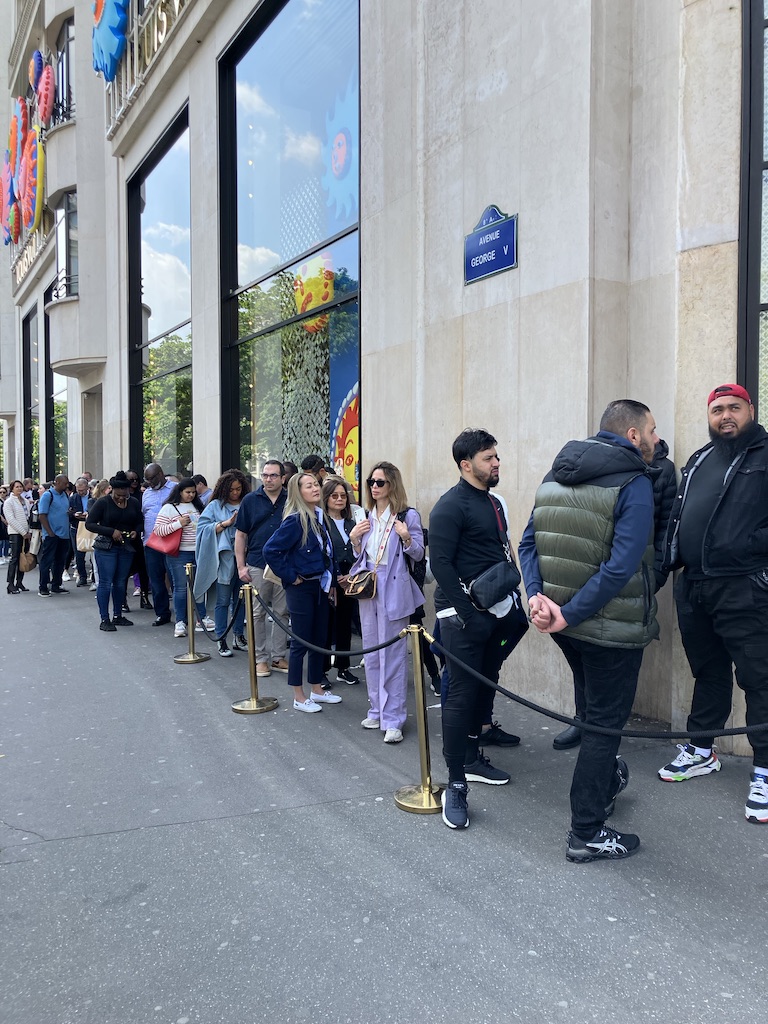


Perhaps they notice in passing that the marvelous army of street-cleaners, the hijab-wearing nou-nous pushing blond babies in prams, the check-out women in small groceries, all have dark to darkest complexions. So what? Do they wonder where these workers go home to at night? Not to the 8th or 16th or 3rd, that’s for sure. Thanks to the centrality of Airbnb’s, nice hotels, and fabulous attractions (always too much to see, dear!), even mavens who visit with passionate annual regularity may never wander into, say, the 19th or 20th arrondissement, or the bleak Stalinesque apartment blocks around the well-named Metro Station Kremlin-Bicêtre.
Too bad for them. Because warmth, wit, scalding hot colors, alluring music and mouth-watering food aren’t found under the Tour d’Eiffel. They’re under the elevated tracks and in the cobble-stone alleys of a parallel Paris. Hardly hidden. Just hop on the Metro to Chateau Rouge…


 POINT de VUE: PARIS
An intriguing glimpse of the parts of Paris that we visitors rarely see. I’m reminded of China Miéville’s brilliant science fiction/murder mystery, The City and The City.
As always so informative. I’ll be sure to follow your advice next time I’m in Paris and head to Chateau Rouge..
Wonderfully focused, and the photos make a perfect closing.